
Tuesday, January 28, 2014

"An Apostle for Peace..."

And a Dream Deferred
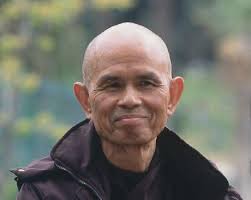
Image from cloudcottage.org


There’s a group at work trying to award my Sensei the Nobel Prize for Peace for which he was nominated in 1967. I couldn’t be more thrilled!


Anyone who’s read my posts over the years knows that the spiritual teacher I quote more than any other is the Vietnamese Zen Master Thich Nhat Hahn. I think he’s an extraordinary human being, a unique embodiment of peace and tranquility. He also has some of the most venerable company one could hope for: none other than Dr. Martin Luther King, Jr.


When Dr. King first started doing his landmark civil rights work in the United States, his focus was on racism and poverty. Although his nonviolent philosophy caused him to regard the Vietnam War as an exercise in madness, he had been warned not to take on the anti-war label. Many of his supporters believed that this singular hot-button issue would alienate key supporters and detract from the civil rights struggle. It wasn’t until after King had met Thich Nhat Hahn that he began to see racism, poverty and war as “the three-part scourge of humanity.” When he learned of the suffering of the Vietnamese people, he began to recognize it as inextricably linked to the struggle of people of color in the United States.


Nhat Hahn was a young monk in Vietnam in an area that had been under continual bombardment from the Viet Cong, the South Vietnamese, and the Americans for years. He founded what would come to be known as “engaged Buddhism” in response to this crisis, arguing that it was immoral for monastics to sit in the monastery meditating while people in the nearby villages suffered the effects of almost nonstop aerial bombardment. With a few other courageous monks and nuns, he founded his School of Youth for Social Services and went to where the bombs were falling to relieve the suffering in any way possible. Because he and his fellow monastics insisted that the war was the result of wrong perceptions -- refusing to take sides -- they were hated equally by those warring factions. Nhat Hahn saw friends blown apart by bombs; many of those friends were maimed or killed. He himself narrowly escaped death when a grenade was thrown through his window, bounced off the wall and exploded in an adjacent room. A few Vietnamese Buddhist nuns were so driven to despair and madness by the constant violence that they self-immolated. He knew something needed to be done quickly, and saw a potential strong ally in Dr. King.


In his letter, he told the civil rights leader that his people saw him as a Bodhisattva, a “great, enlightened being.” He wrote of the suffering of the villagers, and pleaded with Dr. King for his help, saying that many of the seeds of the conflict in his homeland originated in the United States. Still, he refused to take sides; he only wanted to stop the violence.


Dr. King met Thich Nhat Hahn, and was so deeply impressed by the man that he nominated him for the Nobel Peace Prize. In his nomination essay, he wrote,


I do not personally know of anyone more worthy of the Nobel Peace Prize than this gentle Buddhist monk from Vietnam. He is an apostle of peace...his ideas, if applied, would build a monument to ecumenism, to world brotherhood, to humanity.


As a result of his outspoken resistance to the war, Thich Nhat Hahn was exiled from his homeland and eventually took up residence in the French countryside. He gradually gathered friends and fellow practitioners and established a community of practice known as Plum Village Mindfulness Practise Centre. In the ensuing decades, the community would train hundreds of monastics and provide retreats for thousands of lay practitioners. In addition to writing extraordinary books such as Living Buddha, Living Christ and Peace Is Every Step, Nhat Hahn has founded a monastic order known as the Order of Interbeing. He has also offered retreats specifically for veterans of the Vietnam War (both Vietnamese and American together) and for Palestinians and Israelis. At these retreats, he helps these people to understand that seeing the other group as the source of all their suffering is a delusion. Rather, he stresses learning to see members of the other group as human beings who also suffer. Ultimately, he says, our suffering is the result of wrong perceptions, a failure of compassion, and a lack of understanding that we are all inextricably linked as human beings. The suffering of one is the suffering of all; the happiness of one is the happiness of all. This fundamental rejection of dualistic thinking lies at the heart of all his philosophy and instruction. It has relieved a great deal of suffering and has helped to thrust the message of mindfulness onto the world stage.


We recently celebrated the birthday of Dr. King. In honor of his legacy and his unfulfilled dream of seeing Thich Nhat Hahn awarded the Nobel Peace Prize, the international group Fellowship of Reconciliation (FOR) has set about trying to make that happen. Nhat Hahn is now 86, and still teaching around the world. I share the group’s vision to honor both Dr. Martin Luther King, Jr. and “this gentle Buddhist monk from Vietnam” during the latter’s lifetime, and I invite you to join me! Please click here for more information:  http://forusa.org/blogs/for/thich-nhat-hanh-for-nobel-your-nomination-for-for-peace-prize/11761.


Saturday, January 18, 2014

The Most Fundamental Attack on Our Essential Integrity

Image from fairobserver.com

And How to Deflect It Nonviolently

It bears repeating, again and again, that human morality and ethics predate all forms of religion and philosophical schools. They are innate characteristics of Homo sapiens; their root can be seen in the reciprocity practiced by other primate species. The often-repeated epithet that we are incapable of behaving ethically without subscribing to a particular belief system should never stand unchallenged. It is the most fundamental and ubiquitous attack on our essential integrity as human beings.

Those of us who are of a secular mindset have to deal with this form of libel on an almost daily basis. The argument that nonbelievers are incapable of ethical behavior was decisively laid to rest by philosophers centuries ago, and is proven false today by the many ethical humanists and atheists today; nevertheless, it persists. Unfortunately, in some segments of contemporary society, such specious judgments are culturally reinforced in a powerful way. Yoga practitioners are hardly immune; the ridiculous view that they somehow open themselves up to “demonic forces" surfaces perennially.

I can't help but wonder if the people stating these views have ever thought them through to their logical conclusions. Essentially, they are saying that without an invigilating celestial entity, the vast majority of human beings in general would behave like sociopaths. Ours is a primate species, the members of which depend on one another for survival. Had we not enforced our innate cultural taboos on behaviors like murder, rape, theft, and perjury, we most likely would have become extinct long ago. Indeed, societies that fail to observe the universal taboos (including incest and cannibalism) do tend to die out in short order.

People who argue this way make us secularists distinctly nervous. In effect, they are telling us that, absent a cosmic “Big Brother” watching over their shoulders, they would act like the Jeffrey Dahlmers of the world.

To find that this is demonstrably false, one need look no further than societies whose majority religions are non-theistic. Think of the Asian societies in which Buddhism and Confucianism were regnant: they did not produce more than their share of sociopaths and psychopaths. One might fall back on the argument that “at least they had some form of religion.” That’s fine as far as it goes, but it ignores other demonstrable facts. Today, some of the countries with the lowest crime rates in the world are also the least religious. Sweden, for instance, has a remarkably low incidence of crime, with homicide rates lower than 0.1 per 100,000 citizens. Yet, according to a 2010 Eurobarometer Poll, fewer than 18% of Swedish citizens believe in a personal god. And in the United States, the states with the highest rates of violent crime, pornography consumption and child abuse are found in what is known as the Bible Belt.

Of course, it would be intellectually dishonest to assert that religiosity or the lack thereof is the sole determinant of violence and crime in a society (coincidence does not necessarily indicate causation). Many other elements come into play: existential security, geopolitical significance to neighboring countries, monetary resources, and income disparity are all powerful determinants of a country’s crime rates. Nonetheless, the specific argument I’m addressing: the notion that without god, Homo homini lupus ("man is wolf to man"), crumbles when one looks at the facts.

There’s another reality of which most yoga and meditation practitioners are no doubt personally aware: those who engage in these practices regularly -- some of whom are religious while others are not -- are some of the most peaceable people on the planet. This should come as no surprise; a practice that encourages introspective awareness, holistic living, and a deep respect for the interconnected nature of all things can't help but have a positive impact on its practitioners.That influence tends to overflow toward other living beings.

I am not inherently hostile toward religion. I consider it an important anthropological and cultural phenomenon that can serve societal cohesion, help people find peace of mind, and encourage them to live according to the universal treat-others-as-you-wish-to-be-treated dictum. Like any other human institution, however, it can go terribly wrong. On any given day, one cannot open a newspaper or watch televised news without discovering that sectarian conflicts -- based largely on religious differences -- are causing slaughter and mayhem around the world. While it’s fortunately true (although counterintuitive) that violence is actually decreasing around the world, the Pew Research Center recently reported that “violence and discrimination against religious groups by governments and rival faiths have reached new highs in all regions of the world except the Americas” (Reuters, January 14, 2014). Something is clearly wrong here.

Mohandas Gandhi famously said that “In reality there are as many religions as there are individuals.” Add the words “and/or philosophies” to that statement, and I wholeheartedly agree. Perhaps it’s time for the question to be altered and inverted: how may human beings live morally and ethically with the global profusion of god-concepts -- and the violence they seem to generate?


Wednesday, January 1, 2014

Toward a More Humane Society

Image from imperfectspirituality.com

As we say goodbye to 2013, I  know many will join me in hoping to see a wholesale societal shift toward more inclusive, humane, and compassionate living in the coming year. Last year saw more than enough divisiveness, hatred, and violence in our society for many decades.

Our Wiccan friends say that whatever energy you put out comes back to you three-fold. While I haven’t seen evidence to support that claim specifically, I share the sentiment; karma’s fairly reliable. The Hebrew teachers Jesus of Nazareth and Rabbi Hillel both taught their followers that treating other people the way one wished to be treated was the heart of true spirituality. The Buddha said, “Hurt not others in ways that you yourself would find hurtful.” Humanist writer Adam Lee, in his book subtitled Decalogue for the Modern World, wrote the following:

“Do not do to others what you would not want them to do to you [is]...the single greatest, simplest, and most important moral axiom humanity has ever invented, one which reappears in the writings of almost every culture and religion throughout history, the one we know as the Golden Rule.”

Clearly, the idea is a universal human one. If you want to get 100% cerebral about it, it just makes sense: members of a hominid species that needs to cooperate to survive need to look out for each other. Competition is inevitable, but cooperation is essential.

I’ve said in other posts that I do a lot of arguing--both online and off--and it’s true. I love dialectic; I deeply enjoy the art of disputation on substantive issues. I also try to do my best (although I sometimes miss the mark) to stick to the issue being debated rather than devolving into ad hominem attacks on my opponent. It really is my hope that any debate “victory” is also an affirmation of civility, reciprocity and compassion. When the topic is one that makes one “think with the blood,” this can be challenging; still, it’s more than worth the effort.

I’d like to suggest that we dedicate our individual practices to the achievement of a more compassionate and humane society. It starts with each of us individually, after all: peace with oneself leads to peace in relationships, in families, in societies...which is the best chance we have for peace in the world. Have a splendid 2014, everyone!


Copyright Ⓒ 2013 by William K. Ferro

All rights reserved

Friday, November 22, 2013

Your Struggles Are Still Legit!


Dealing with a Common Psychological Side Effect of Caregiving

Image from stampingismybusiness.com


When you have a loved one who’s struggling with a genuinely life-threatening illness, there’s a tendency to sublimate your own struggles and difficulties on the grounds that they don’t measure up. I mean, yeah, you may be busting to make a deadline or dealing with a seemingly insurmountable obstacle in your life. But it hardly rises to the status of cancer, heart disease, or (fill in the blank here), does it? You may feel guilty for even countenancing these things as problems, considering the magnitude of what this other person in your life is going through. As a result, you shove them down into your subconscious and try to proceed as if they aren’t there.

The problem with this strategy, of course, is that buried anxiety has a tendency to come back--in a more virulent form--to bite you and your recovering loved one.

Ever since Freud’s groundbreaking work on the subconscious mind went mainstream, more and more people have come to understand the remarkable power this region of consciousness exerts over body, mind and soul. Anxiety and depression buried beneath the surface do not disappear; rather, they tend to fester and have deleterious effects on one’s mental and physical health.

When your mind and body are under attack from virulent strains of small, buried griefs, your ability to be of any use to that person who’s fighting a disease is compromised. So it only makes sense to embrace your problems and struggles, to talk about them, to let them heal through communication with other people. And that includes the person you’re most concerned about! If she’s a compassionate, understanding person (and suffering can have that effect on people who are open to finding the good in the bad), she’ll be just as interested in what’s eating you as what she’s up against. In fact, serving as a listening ear for you may have a healing effect in itself: her mind can focus on someone else for awhile, and that can be great for one’s health.

So don’t be afraid to talk about what’s bugging you, just because someone you care deeply about has a “more important” problem. As James Taylor said, “Once you tell somebody the way that you feel, you can feel it beginning to ease.” Great advice, worth taking to heart!

Saturday, November 16, 2013

Everyday Epiphanies

Image from riverdaughter.com

We’ve all experienced them: those flashes of recognition in which we suddenly perceive
something familiar in an entirely new light. Simply by being open, sensitive, and receptive, we can make these epiphanies--­­usually understood to be rare phenomena­--­ nearly everyday events. And experiencing them on a regular basis need not by any means cheapen their significance.

There is probably nothing quite like a mindfulness meditation practice to place us in the
receptive mental state that leads to these deeply life-­affirming realizations. Meditation turns down the noise in one’s mind, allowing these wonderful experiences to occur frequently and with clarity.

Probably the most significant epiphany I’ve experienced recently is the deep realization of the fact that we are literally made of the remnants of exploded stars. When stars die, they explode, sending out in all directions the elements that make life possible. The iron in our blood, the calcium in our bones, the electrons that form thoughts in our brains; these all once resided within the stars. Carl Sagan used to refer to this as our being “made of star stuff.” Such a beautiful and profoundly poetic idea:­­ that we are indeed one with the universe at a molecular level!

This epiphany leads naturally to another: that we are all part of the web of nature; that
everything is interconnected. The Buddhist monk Thich Nhat Hahn gave his monastic order the name The Order of Interbeing; he explains the concept as follows:

"In Buddhism the most important precept of all is to live in awareness, to know what
is going on…to be aware of what we do, what we are, each minute. When we are totally mindful—in direct contact with reality, not just images of reality—we realize that all phenomena are interdependent…endlessly interwoven."

You and I are parts of exploded stars as well as parts of one another. There is no such thing as a completely independent self;­­ all selves are composed of non-­self elements. When we come to understand the oneness and interwoven nature of all things, compassion for other selves becomes as natural as breathing. Concern for the environment grows out of the deep realization that we are the environment, and the environment is us. If we poison it, we poison ourselves. When we nurture it, we nurture ourselves, and all other selves as well.

Living in a state of ongoing mindfulness, which is the natural, everyday outworking of our
meditation practice, produces these flashes of insight in the midst of the ordinary and the
mundane. They can come while we are preparing food, washing dishes, caring for our
families, doing our work, and enjoying our free time. Everyday epiphanies are what I am
most grateful for in this, the season of gratitude.

Thursday, October 31, 2013

'Tis the Season...

...for Walking Meditation!

Image from eattheweeds.com


Autumn has come to our little town by the Chesapeake Bay. The air is chill, the leaves are a symphony of colors, and the time has come for some serious walking meditation.

What’s walking meditation? It’s simply meditating while walking. It’s all about finding your stride and letting it take the place of your seated position during sitting meditation. Walking peacefully and in touch with the beauty of our surroundings, we fall into a rhythm, our feet making gentle contact with the earth. We become aware of everything: our breath, our heartbeat, the earth and sky. We take in the distinctive aromas of fall, the dappled sunlight, the bracing chill of the late October air.

The object is not to achieve anything; we simply want to be aware: aware of what is happening inside us and all around us. Some walking meditation practitioners count their breaths and cultivate an awareness of how those breaths grow deeper and longer throughout the walk. Others sync up their steps with their in- and out-breaths, silently repeating a mantra all the while. Others find that this distracts them too much from the beauty of their surroundings: they miss too much by over-concentrating. On the other hand, you don’t want “monkey mind” to set in, letting your thoughts fly to the future and the past. Whatever keeps you rooted to the present moment is recommended!

In this, my favorite season, it’s very important to me that I not miss any of the sights, sounds, and smells unique to this time of year. I’m reminded that the leaves of the trees are beautiful in death, and that death is not extinction. Rebirth will occur in the spring; like the leaves, I will eventually fall to earth, providing food for new life to grow. Seen in this way, a death can be as beautiful as a birth. All this I’ve intuited (and it’s become undeniably real to me) while doing walking meditation on autumn days near the Chesapeake. Autumn afternoons and evenings are like poignant poems; they are to be savored, and are made even sweeter by the knowledge that winter is close on their heels.


Copyright Ⓒ 2013 by William K. Ferro
All rights reserved

Thursday, October 24, 2013

Samhain Approaches!


The Precursor to Halloween

What are the roots of Halloween? How did the celebration get started?

It all began with the pagan celebration of Samhain, a word meaning “Summer’s end” in the Brythonic branch of Gaelic. The pagans of the British Isles saw the date as the official end of summer, and one of several “thin times” of the year. By “thin,” they meant that the veil between the world of the living and that of the dead was more porous than usual; spirits could easily pass through the veil and interact with the living. This, and the fact that some in these agrarian communities might or might not survive the winter (depending on how successful the harvest had been) accounted for the death-related themes of the holiday. This obviously continued in the Halloween (All Hallow’s Eve) holiday that Samhain preceded.

When the tribe gathered around the bonfire on Samhain night, the flames
would attract bats. With the fire being the only source of light, they resembled capering spirits, reinforcing the belief that the spirits of the recently dead were crossing over into the realm of the living. While the pagans worshiped gods and goddesses, there were still strong remnants of ancestor worship among them. They believed that the spirits of family and friends had to be appeased to ensure good fortune-- something that could easily be a matter of life and death. This is where the practice of going from house to house and asking for treats came from: children (and not a few adults) would offer to make sacrifices to the gods and the recently dead on behalf of each household they visited in exchange for treats.

When Emperor Constantine made Christianity the official religion of the Roman Empire (outlawing pagan practices in the process), the Church appropriated Samhain and turned it into All Hallow’s Eve, a Holy Day of Obligation when Christians were to appeal to the saints for the quick release of their deceased loved ones from purgatory. The house-to-house begging that would eventually become known as trick-or-treating took on this new aspect: the children at the door promised to pray for the release of the household’s recently dead from purgatory in exchange for “soul cakes.”

The death-related themes have persisted into modern celebrations of Halloween. It is the one day of the year when we are allowed to mock death and make it entertaining. If you were to put up the traditional funereal Halloween decorations outside the house any other time of year, you would run a real risk of being arrested!


Copyright Ⓒ 2013 by William K. Ferro

All righs reserved