Friday, March 20, 2015

A Better Society Is Possible...for Everyone

Image from www.thecostariconews.com


A country’s budget proposals are ethical and moral documents; they reflect what a society considers important. When a budget is proposed that would take what little is set aside for the most vulnerable, when it would literally take food out of poor children’s mouths to pad the bank accounts millionaires and billionaires, persons of conscience have to speak up and wholly reject it as antithetical to their values.

When policy is set by extremely wealthy politicians beset by The Three Poisons (hatred, greed, and delusion), the results are predictable. The dystopian vision some statesmen have for this country is irredeemably ugly. If civilization implodes (a not-unlikely scenario, given the reverse-Robin Hood policies being proposed), it will take the very rich down with it, of course. I suppose it’s possible for the “haves” to imagine that fortified bunkers and private mercenary armies will protect them from the desperate “have-nots” once the latter are completely disenfranchised. Of course, this is a delusion.

With profound calm, overflowing generosity, and crystal clarity -- the glorious opposites of The Three Poisons -- we have to resist, to demand social justice. A better society can be built, one that includes all citizens and is fully invested in humanitarian values.

I call on all humanists, secular and religious, to join in generating the mindful awareness required to transform our society from within. A genuinely humane, generous and civilized society is possible. Multiple studies around the world have shown conclusively that societies with the lowest income disparities are the most successful and happiest. Everyone in such societies, including the wealthiest few, tend to do better. They have less to fear; they need not arm themselves to the teeth and employ bodyguards.

The current climate of profound cynicism, extreme polarization and disaffected alienation in the United States can be transfigured. It will take a complete, heartfelt commitment on the part of all the humane and civilized individuals we can find.


Thursday, March 19, 2015

Arising from Impermanence


meditate.jpg


She rises high above the din
Of frenzied voices, shouting slurs.
She is an island to herself;
Nobility, a tranquil sense,
Arising from impermanence.


Look at all the happiness
Her herbal garden brings.
She steps outside herself tonight
To hear her spirit sing.


She dances in the morning,
And she wanders in the night.
Her heart is rediscovered
As her spirit soars in flight.


She steps outside herself today,
Looks inward from without.
Finds sweet validation there;
Ego boundaries disappear,
As the glass begins to clear.


She rises high beyond the reach
Of propaganda and of lies.
She’s made a home within herself;
Nobility, a tranquil sense,
Arising from impermanence.

Wednesday, April 23, 2014

Four Simple Steps


The Way of Mindfulness Meditation

These are the simple steps involved in mindfulness meditation:

Step One: Stop.

Step Two: Sit.

Step Three: Breathe.

Step Four: Be aware.

The first step, stopping, is essential. Our very survival depends on our ability to stop: to stop polluting the air, water and soil; to stop ingesting carcinogens; to stop engaging in hostile international actions in an age of apocalyptic weaponry. Enlightenment also requires a pause. To reach it, we need to cease our constant running from activity to activity, to give ourselves a brief opportunity to simply be. We need to temporarily stop our usual whirlwind of activity and give our minds a break from the never-ending sources of stimulation that assault our senses day and night. Stopping is the first, and most essential, step in meditation.

The second step is sitting. There is nothing more liberating than allowing ourselves to sit quietly in simple awareness for awhile. We can sit in any comfortable position: in a chair, on a cushion, in the half-lotus or full-lotus position. Our minds follow our bodies, and our bodies follow our minds. When we allow ourselves to sit comfortably with no agenda except to be, our minds take their cue from our bodies.

The third step is breathing. Of course, we are always breathing (no breath, no life!), but I’m talking about conscious breathing: awareness of our in-breath and out-breath. As we become aware of this phenomenon that enables our living, it reveals itself as the miracle it truly is. We gradually become aware of our respiration becoming deeper, smoother, and more pliant. And speaking of awareness…

...The fourth step is being aware. Mindfulness meditation can be defined as sitting in awareness of what’s going on within us and around us. It’s not an escape from life, but a wholehearted embrace of it. As we sit in simple awareness of our in- and out-breaths, we become more cognizant of our own mental states. Self-understanding at a profound level becomes possible. What we should and should not do in response to our environment becomes clear. It’s like placing a glass of sediment-filled water on a table and watching it for 20 minutes or so: the sediment gradually sinks to the bottom of the glass and the water becomes clear.

The clarity we achieve through meditation works in the same way. The sediment -- unresolved issues, troubled mental formations and tension -- all fall away and we are left with a mind like clear, still water.

Saturday, March 1, 2014

Have Trouble Relinquishing Control?


Releasing It Can Enrich Your Life

Do you need to exert perpetual control over all aspects of your life? Are you a “mood manager,” who even tries to exercise control over how others feel, speak and act? If you have this kind of personality, you know how exhausting and frustrating it can make your life. Who knows? Maybe this was what drew you to yoga and meditation in the first place-- you recognized your need to deal with this aspect of your personality.

What drives our “control issues?” Well, consider the fact that our very presence on the planet is the result of a confluence of events over which we had no say. The mutation of cells, or some other random event, will likely bring our lives to a close. In between, as children, we grow up learning that we have little power to influence the way things go. For many people, this sense of powerlessness continues into adulthood. Aging then returns us to the relatively dependent state we experienced in childhood. All this being the case, it is hardly difficult to understand why we would try to exert control over the things we can.

Of course, not all of this influence-seeking is unhealthy. As adult, autonomous individuals, we actually have a responsibility to guide the course of events in our sphere of influence in a positive manner. But of course there’s a big difference between offering a guiding hand and demanding absolute control. At the latter extreme lie serious personality disorders and all manner of pathology.

Meditation is a wonderful means of confronting our control issues. Rather than trying to eradicate them -- a futile exercise -- we sit with those issues and look deeply into their genesis. Contemplation can lead to understanding; in the deeply relaxed, receptive state of mind that meditation induces, we can recognize these predilections, smile at them, and allow them to be. This avenue can bring release, whereas a conscious effort to eradicate our desire for total control often backfires. It can engage our habit energy, causing our minds to double down on old, unhealthy patterns.

Wednesday, February 26, 2014

The Mindfulness Phenomenon


An Ancient Discipline Makes the 21st Century Scene

Mindfulness is showing up more and more in the public eye these days. Every other day, it seems, we hear more about the efficacy of mindfulness techniques -- in university studies, in school programs, and in medical research.
In short, mindfulness has gone mainstream. (I feel as if we holistic spirituality practitoners need T shirts that read, “I was into mindfulness before mindfulness was cool!”)
A mere ten or so years back, the term was virtually unknown outside of meditation and holistic spirituality circles. Now, it’s practically a household word. This has been enabled by studies carried out by cognitive researchers, a profusion of articles on the topic, and even instruction for managing stress for everyone from schoolchildren to CEOs.
There have been more and more testimonials on mindfulness meditation’s wide array of benefits as well. People dealing with chronic pain, suffering from anxiety and depression, or in search of a natural means of managing everyday stress have all benefited from the technique.
Scientific findings strongly support these testimonials. The American Psychological Association (an organization known for its empirical rigor) reports that mindfulness meditation improves concentration and memory, reduces the unhealthy effects of stress, and decreases “emotional reactivity” (our tendency to react on “auto-pilot” rather than respond thoughtfully).* The mental process that psychologists call “rumination” seems to respond particularly well to mindfulness practice. The term refers to our habit -- more pronounced in some than in others -- of mulling things over and over in our minds, considering all the ways something could go wrong. We are pattern-seeking animals, and our ability to extrapolate likely outcomes from a given set of circumstances has helped us to survive and thrive. But this ability comes at a price: our minds can easily become trapped on a never-ending hamster wheel of “what-ifs.”
Mindfulness meditation centers us in the present moment as we concentrate on our breath and become fully aware of what is happening both within us and around us. I wrote this short poem (A Sacred Stillness) in my early days of mindfulness practice:
There is a sacred stillness to which we may return,
There to rediscover our true nature.
In this present moment, merely breathing in an out,
Illusion falls away and I am free.
I’m glad this ancient practice is having its moment in the 21st century sun. Our contemporary world needs a lot more of the simple wisdom the practice offers; the more people are exposed to its benefits, the better!

* What Are the Benefits of Mindfulness?  Daphne M. Davis, PhD, and Jeffrey A. Hayes, Phd, Julh/August 2012, Vol. 43 # 7.

Tuesday, February 4, 2014

Nature's Vast Web of Life


On many occasions, I’ve heard people observing the behavior of chimpanzees and other Great Apes say, “Wow, that’s kind of scary.” Invariably, they’re talking about the clear similarities between these animals and ourselves.

But why should our close kinship to our closest primate cousins inspire uneasiness, rather than wonder and amazement? The realization that our species is an inextricable part of the web of nature can be deeply comforting. This kinship doesn’t diminish our own uniqueness, any more than it does the uniqueness of chimpanzees, gorillas, or bonobos.

When I watch a chimpanzee fashioning a crude tool out of a stick and using it to extract a tasty snack of ants from a fallen log, I’m filled with amazement. I’m reminded that intelligence exists on a continuum from the simplest multicellular organisms to Homo sapiens. Even outside the realm of the primates, signs of intelligence and personality in the animal kingdom abound. Anyone who has kept more than one dog or cat can testify to each animal’s unique personality! In varying degrees, all mammalian mothers care for and nurture their offspring. All animals experience fear, and many demonstrate rich and varied emotional lives. This can be seen in domestic animals of all kinds, which apparently feel everything from instinctual fear to what we would call jealousy, anger and love. Even in the wild, we see example after example: the wolf’s fierce devotion to the pack, dolphins’ highly complex social behavior, and nearly every animal’s solidarity with others of its kind.

So why the “scary” when observing primate behavior?

I think it’s a bit of leftover angst about the loss of our “special” status. Before the advent of the scientific method, everyone “knew” that we were the center of the universe. To paraphrase the Greek philosopher Protagoras, humanity was “the measure of all things.” This solipsism is hardly surprising; it’s precisely what one would expect of a species that had only recently made the transition from sentience to self-awareness (and in evolutionary terms, we made that leap less than a moment ago). With each great scientific discovery, however, our status was further diminished. Galileo proved that the earth revolved around the sun, divesting our planet of its centrality in the solar system. Leeuwenhoek and others upset our Dominionist apple cart by discovering previously unknown microbes; gradually it became clear that it was they that had dominion over us. Finally, Darwin’s theory of evolution by means of natural selection dealt a fatal blow to the belief that human beings were placed here by a special act of creation. No wonder we felt ill at ease, and that some of this uneasiness persists!

Nonetheless, once you’ve embraced your identity as a member of one mammalian primate species among many, a most wonderful sense of universal connectedness follows. The Buddhist concept of the oneness of all living things is confirmed by scientific experimentation; one can truly begin to see the universe in a single atom! This is thrilling, liberating, but it also contains the seeds of disturbance. Suddenly we find ourselves painfully aware of the damage we’re capable of: we have the power to wipe out other species -- along with our own -- and to make the biosphere uninhabitable.

Fortunately, the converse is also true. An awakening to our place in nature’s web empowers us to protect the environment, preserve endangered species, and improve the lives of our fellow human beings. We can consciously choose to replace our old tribal allegiances with a new, global ethos. These new competencies more than compensate for any remaining uneasiness we may feel due to our loss of status. We are now free to observe our primate relatives acting in many of the same ways we do without any anxiety or uneasiness. In their place, we can embrace a sense of joy and wonder at the vast, interconnected web of nature-- and our unique part therein.


Tuesday, January 28, 2014

"An Apostle for Peace..."

And a Dream Deferred
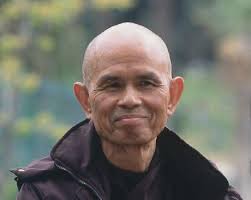
Image from cloudcottage.org


There’s a group at work trying to award my Sensei the Nobel Prize for Peace for which he was nominated in 1967. I couldn’t be more thrilled!


Anyone who’s read my posts over the years knows that the spiritual teacher I quote more than any other is the Vietnamese Zen Master Thich Nhat Hahn. I think he’s an extraordinary human being, a unique embodiment of peace and tranquility. He also has some of the most venerable company one could hope for: none other than Dr. Martin Luther King, Jr.


When Dr. King first started doing his landmark civil rights work in the United States, his focus was on racism and poverty. Although his nonviolent philosophy caused him to regard the Vietnam War as an exercise in madness, he had been warned not to take on the anti-war label. Many of his supporters believed that this singular hot-button issue would alienate key supporters and detract from the civil rights struggle. It wasn’t until after King had met Thich Nhat Hahn that he began to see racism, poverty and war as “the three-part scourge of humanity.” When he learned of the suffering of the Vietnamese people, he began to recognize it as inextricably linked to the struggle of people of color in the United States.


Nhat Hahn was a young monk in Vietnam in an area that had been under continual bombardment from the Viet Cong, the South Vietnamese, and the Americans for years. He founded what would come to be known as “engaged Buddhism” in response to this crisis, arguing that it was immoral for monastics to sit in the monastery meditating while people in the nearby villages suffered the effects of almost nonstop aerial bombardment. With a few other courageous monks and nuns, he founded his School of Youth for Social Services and went to where the bombs were falling to relieve the suffering in any way possible. Because he and his fellow monastics insisted that the war was the result of wrong perceptions -- refusing to take sides -- they were hated equally by those warring factions. Nhat Hahn saw friends blown apart by bombs; many of those friends were maimed or killed. He himself narrowly escaped death when a grenade was thrown through his window, bounced off the wall and exploded in an adjacent room. A few Vietnamese Buddhist nuns were so driven to despair and madness by the constant violence that they self-immolated. He knew something needed to be done quickly, and saw a potential strong ally in Dr. King.


In his letter, he told the civil rights leader that his people saw him as a Bodhisattva, a “great, enlightened being.” He wrote of the suffering of the villagers, and pleaded with Dr. King for his help, saying that many of the seeds of the conflict in his homeland originated in the United States. Still, he refused to take sides; he only wanted to stop the violence.


Dr. King met Thich Nhat Hahn, and was so deeply impressed by the man that he nominated him for the Nobel Peace Prize. In his nomination essay, he wrote,


I do not personally know of anyone more worthy of the Nobel Peace Prize than this gentle Buddhist monk from Vietnam. He is an apostle of peace...his ideas, if applied, would build a monument to ecumenism, to world brotherhood, to humanity.


As a result of his outspoken resistance to the war, Thich Nhat Hahn was exiled from his homeland and eventually took up residence in the French countryside. He gradually gathered friends and fellow practitioners and established a community of practice known as Plum Village Mindfulness Practise Centre. In the ensuing decades, the community would train hundreds of monastics and provide retreats for thousands of lay practitioners. In addition to writing extraordinary books such as Living Buddha, Living Christ and Peace Is Every Step, Nhat Hahn has founded a monastic order known as the Order of Interbeing. He has also offered retreats specifically for veterans of the Vietnam War (both Vietnamese and American together) and for Palestinians and Israelis. At these retreats, he helps these people to understand that seeing the other group as the source of all their suffering is a delusion. Rather, he stresses learning to see members of the other group as human beings who also suffer. Ultimately, he says, our suffering is the result of wrong perceptions, a failure of compassion, and a lack of understanding that we are all inextricably linked as human beings. The suffering of one is the suffering of all; the happiness of one is the happiness of all. This fundamental rejection of dualistic thinking lies at the heart of all his philosophy and instruction. It has relieved a great deal of suffering and has helped to thrust the message of mindfulness onto the world stage.


We recently celebrated the birthday of Dr. King. In honor of his legacy and his unfulfilled dream of seeing Thich Nhat Hahn awarded the Nobel Peace Prize, the international group Fellowship of Reconciliation (FOR) has set about trying to make that happen. Nhat Hahn is now 86, and still teaching around the world. I share the group’s vision to honor both Dr. Martin Luther King, Jr. and “this gentle Buddhist monk from Vietnam” during the latter’s lifetime, and I invite you to join me! Please click here for more information:  http://forusa.org/blogs/for/thich-nhat-hanh-for-nobel-your-nomination-for-for-peace-prize/11761.